
Chair Yoga & Seated Exercises for Seniors Over 60: A Gentle Guide to Moving Safely at Home
Updated: Dec 15, 2025
Category: Health and Wellness
By Stanley Octavius, DPT, ATC

Reaching your 60s, 70s, or 80s does not mean giving up on movement. What it really means is learning how to move in ways that can protect your joints, support your energy, and your current level of strength. For many older adults, that starts with chair yoga for seniors and simple seated exercises for seniors that can be done safely at home with a sturdy chair.
If you have ever thought, “I know I should exercise, but I am afraid of falling,” you are exactly the person chair-based routines are designed for. You do not need fancy equipment, complicated machines, or long workouts. You need practical, steady movement that helps you stand up more easily, feel steadier on your feet, and stay as independent as possible.
At DIRECC, our goal is to support safe, realistic exercise options for older adults and caregivers. This pillar guide will walk you through why chair exercises for seniors over 60 work so well, how to get started, and how our Active Aging books, wellness journal, video tutorials, and free resources can help you build a routine you can actually keep up with.
Why Staying Active Is So Important After 60
It is very common for activity levels to drop with age. Maybe your knees hurt, your back feels stiff in the morning, or a previous fall has made you more cautious. Over time, less movement usually leads to weaker muscles, reduced balance, slower reactions, and increased fear of falling. Everyday tasks like getting out of a chair, stepping into the bathtub, or walking outside can start to feel harder than they used to.
The encouraging news is that the body responds to movement at every age. When you incorporate gentle seated exercises for seniors into your week, you give your body a chance to:
● Strengthen the muscles that help you stand, turn, and walk
● Keep joints from stiffening up completely.
● Support heart and lung health.
● Improve circulation and energy.
● Maintain a sense of confidence and independence.
You do not have to do intense workouts. Even daily chair exercises for seniors that last ten to fifteen minutes can make a noticeable difference over time. Think of movement like brushing your teeth. It is not something you do once and forget about. It is a small, regular habit that protects your health in the long run.
What Is Chair Yoga for Seniors?
Chair yoga for seniors is a gentle form of yoga that uses a chair for support. Instead of moving up and down from the floor, you sit in the chair or stand behind it while holding on. That simple change removes a major barrier for many older adults. You can experience the benefits of yoga without worrying about losing your balance or getting stuck on the ground.
Chair yoga focuses on three main elements: breathing, stretching, and mindful movement. You lengthen your spine, roll your shoulders, gently twist your torso, and open your hips, all while staying grounded through the chair. Movements are slower and more controlled than traditional gym-style exercise. The aim is to help you feel more open, more relaxed, and more aware of how your body moves.
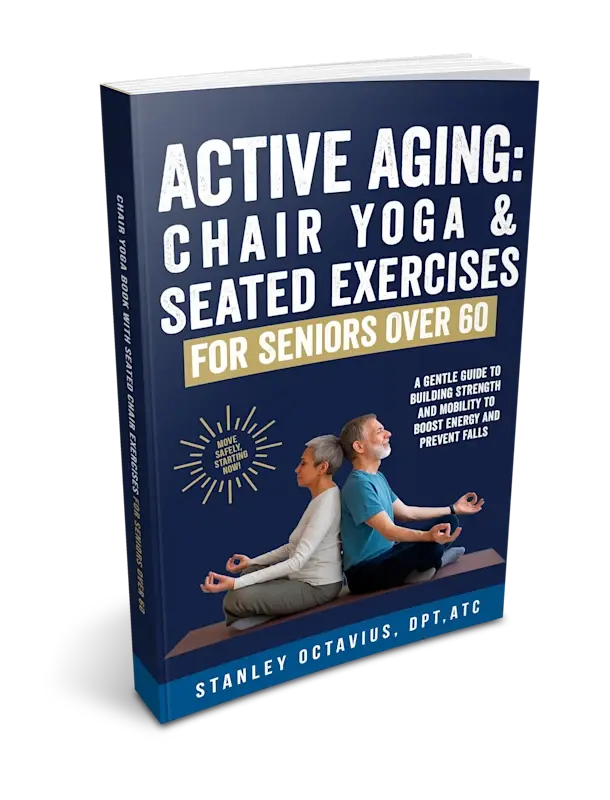
In the Active Aging: Chair Yoga & Seated Exercises for Seniors Over 60 book, the routines are designed so that you always know where to place your feet, how to sit or stand, and how far to move. Each pose is broken down into clear steps, and the focus is on safe, gradual progress, not forcing yourself into deep stretches.
If you are new to yoga or have not exercised in years, this style of practice is a welcoming starting point. You can begin with very small movements, breathe through each one, and slowly expand your range as your confidence grows.
What Are Seated Exercises for Seniors?
While chair yoga leans toward stretching and mindful movement, seated exercises for seniors look more like traditional strength and mobility exercises adapted for the chair. They are simple, repetitive movements that strengthen muscles and keep joints moving without putting too much pressure on them.
For example:
● Seated Hamstring stretch
Sit tall in a sturdy chair.
Extend one leg straight in front of you with your heel on the floor and toes up.
Gently hinge forward from your hips, keeping your back straight, until you feel a stretch behind your thigh.
Hold 30–45 seconds and breathe. Switch legs.

● Seated calf raises
Sit tall with both feet flat on the floor.
Lift your heels up as high as you can while keeping your toes on the ground.
Pause at the top, then slowly lower your heels back down. Repeat for 3 sets of 10.

● Seated marches
Sit upright with feet flat on the floor.
Lift one knee toward your chest, lower it, then lift the other knee while marching in place.
Keep your core engaged and continue alternating legs at a comfortable pace.
3 sets of 45 seconds

● Seated knee extension
Sit tall with both feet on the floor.
Slowly straighten one knee until your leg is extended, squeezing the thigh.
Hold briefly, then lower with control.
Repeat and switch legs. 3 sets of 10.

● Seated crunches
Sit tall with feet flat.
Lift one knee as you rotate your torso and bring the opposite elbow toward it.
Return to the start and repeat on the other side, alternating sides in a controlled rhythm. 3 sets of 10.

These exercises are the foundation of many daily chair exercises for seniors. They are not complicated. Each movement is chosen because it helps with something practical, such as standing up from a chair, stepping over a doorstep, or getting in and out of your car. When you practice them regularly, you are not just exercising for the sake of it. You are training your body for real-life tasks.
Who Can Benefit From Chair Exercises for Seniors Over 60?
Almost any older adult can benefit from chair exercises for seniors over 60, especially if traditional fitness routines feel out of reach. Chair-based routines are a good fit if you:
● Feel unsteady and are worried about falling
● Have arthritis, osteoporosis, or long-term joint pain.
● Use a cane, walker, or other mobility aid.
● Are you recovering after illness, surgery, or a long time in bed
● Have tried standing exercises and found them too hard or painful
● Prefer to exercise at home instead of going to a gym.
They are also a strong option for caregivers. If you are supporting a parent, spouse, or relative, you may feel unsure about what is safe and what is not. Having a clear set of chair exercises for seniors over 60 makes it easier to plan short sessions together. You are not inventing movements on the spot. You are following structured routines created by a professional.
Staying Safe: Simple Setup and Precautions
Safety is the basis of every routine. Before you start, it is always best to talk to your doctor or healthcare provider, especially if you have heart concerns, uncontrolled blood pressure, or recent surgery. Once you get the go-ahead, you can set up a safe exercise space at home.
Choose a strong chair, ideally without wheels and with a solid back. Place it on a non-slip surface, such as a rug or carpet. Sit toward the front of the seat, with both feet flat on the floor and your knees roughly in line with your hips. Keep your chest comfortably lifted, and your shoulders relaxed.
As you move, work with your breath instead of against it. Breathe in through your nose, breathe out through your mouth, and avoid holding your breath during effort. If a movement causes sharp pain, sudden dizziness, or shortness of breath, stop and rest. It is normal to feel your muscles working, but you should not feel unsafe.
These same principles are woven into the routines and explanations inside the Active Aging books and videos. They always bring your attention back to posture, breathing, and comfort level so that you stay in control of your own pace.
A Gentle 15-Minute Chair Routine to Start With
A full-length workout is not the goal on day one. A better approach is to commit to something realistic, like a fifteen-minute routine you can repeat several times a week. Short, consistent sessions beat occasional long sessions every time.
Imagine a simple fifteen-minute session built around daily chair exercises for seniors. You might start by sitting tall and checking your posture. You roll your shoulders slowly forward and backward, then lightly turn your head side to side to loosen the neck. Next, you lift one knee and then the other in a comfortable marching pattern, letting your arms swing naturally by your sides.
After that, you straighten one leg, hold for a moment, and lower it with control, then repeat on the other side. You tap your toes and then your heels, waking up the lower legs. You gently tighten your abdominal muscles, as if zipping up a jacket, and hold for a few breaths to engage your core. You finish with a slow twist, placing one hand on the opposite thigh and turning your chest gently, then repeat on the other side. Finally, you sit quietly, breathing slowly and noticing how your body feels.
To make this even easier to follow at home, DIRECC offers a free 15-minute chair exercises for seniors style chair routine in ebook format. You can request your free guide and get step-by-step instructions for a daily chair-based workout by visiting the wellness resources page or downloading it directly in the form below.

This free guide is a perfect starting point if you feel unsure about where to begin. You can print it, keep it by your favorite chair, and work through the routine at a pace that matches your energy.
Deepening Your Routine With Active Aging Books
Once you have tried a basic routine a few times and feel ready for more structure, it is helpful to have a program that grows with you. That is where the Active Aging books created by Stanley Octavius, DPT, ATC, come in. They are designed specifically for older adults who want to stay active using chair yoga for seniors and seated exercises for seniors at home.
Active Aging: Chair Yoga & Seated Exercises for Seniors Over 60
The main book, Active Aging: Chair Yoga & Seated Exercises for Seniors Over 60, is a comprehensive guide to chair-based movement. It takes you beyond a single routine and gives you a whole series of sequences you can rotate through during the week.
Inside, you will find detailed breakdowns of chair exercises for seniors over 60, from very gentle movements to more challenging variations. Each routine is organized so that you know when to warm up, when to focus on strength and mobility, and when to cool down. There are tips on how to adjust a pose if your knees hurt, how to support your lower back, and how to use the chair in slightly different ways as you improve.
If you want to see the original retail listing for context, you can check it out on Amazon or directly on our website: Check out the Chair Yoga & Seated Exercises book.
Active Aging: 15 Minute Core Exercises for Seniors
The second book in the series focuses on targeted 15-minute core exercises for seniors. At the same time, the first book covers the whole body; this one zooms in on the core region and legs, which is crucial for posture, balance, and back support.
These short routines fit beautifully into a daily schedule. You can add a core session on two or three days of the week, or pair a core routine with a gentler stretching sequence on another day. The exercises are chair-friendly, so you still benefit from a safe, stable base while you challenge your core in a controlled way.
If you want to review the original product details, you can check it out on Amazon, or you can learn more here: Explore the 15 Minute Core Exercises book.

Staying Consistent With a Fitness and Wellness Journal
Starting a new routine is one thing. Sticking with it is another. Many older adults find that they begin with good intentions, then slowly drift back into old habits because they cannot see their progress clearly. A simple way to stay accountable is to track what you are doing and how you feel after each session.
The Active Aging Fitness and Wellness Journal is designed to make that easy. It gives you space to record which seated exercises for seniors you completed, how long you moved, how your joints felt before and after, and what your energy and mood were like. You can also jot down small goals for the week, such as “complete three chair sessions” or “add five more repetitions to my leg exercises”.
Over time, the pages show you a story. You can look back and see that two months ago you could only do a few minutes of marching in place, and now you are comfortably completing a full daily chair exercises for seniors routine. That sense of progress is motivating, and it also gives your doctor or therapist useful information about how your body is responding.
If you are curious about the standalone journal, you can see the original version here: View the Active Aging Fitness and Wellness Journal. In the DIRECC bundle, it becomes a natural partner to the books, turning your exercise into a trackable, sustainable habit.
Visual Support: Video Tutorials and Lifetime Access
Not everyone likes reading instructions. Some people learn best by watching someone move and following along. That is why the Active Aging resources also include video tutorials. These videos demonstrate many of the chair exercises for seniors over 60 that appear in the books, so you can see exactly how each movement should look.
You can pause, rewind, or replay a video until you feel comfortable. You can keep one favorite routine and use it as your regular session on days when you do not feel like reading. Because access is ongoing, you are not rushed. You can move at your own pace, repeat sections as often as you like, and choose the sessions that feel best for your body.
For caregivers, this visual support is especially useful. You can set up a chair next to your loved one, play the video on a laptop or tablet, and follow it together. The structure is already provided, so you can focus on encouragement and safety.
How the Donation-Based Bundle Works With DIRECC
On the DIRECC website, the Active Aging materials are offered in a way that supports both individual health and community impact. Instead of simply selling books, DIRECC invites people to support a nonprofit mission and receive a meaningful thank you.
When someone makes a charitable donation, they can request an Active Aging wellness bundle that may include the Chair Yoga & Seated Exercises book, the 15-minute core exercises for seniors book, the fitness and wellness journal, and access to corresponding video tutorials. In other words, donors are not just giving. They are also receiving a complete at-home program they can use themselves or share with someone they care about.
To learn more about this bundle and see how it fits into the wider wellness resources for seniors, visitors can find all the details here: Explore the DIRECC chair yoga and seated exercises page.

How Caregivers Can Use These Resources
If you are a caregiver, it can be overwhelming to juggle medications, appointments, and daily tasks. Exercise might feel like “one more thing” on a long list. The advantage of having a clear set of chair exercises for seniors over 60 is that the planning is done for you.
You can pick one short routine from the books or videos and treat it as a daily appointment. Perhaps you choose a gentle sequence after breakfast or a core-focused session before an evening TV show. You sit beside your loved one, both of you in sturdy chairs, and follow the steps together.
As you finish each session, you can use the wellness journal to note how it went. Maybe your loved one reports less stiffness or a slightly better mood. Maybe they find standing up a little easier after a week or two. These small changes matter. They remind both of you that your efforts are paying off.
Because the routines are chair-based, they also work well in small spaces. You do not need a home gym. A quiet corner of the living room can become your shared exercise zone.
Putting It All Together: A Realistic Weekly Plan
To see how everything fits, imagine a simple weekly structure built around chair yoga for seniors and daily chair exercises for seniors.
You might start with three days per week. On the first day, you focus on a full-body chair routine from the free ebook, moving gently for about fifteen minutes. On the second day, you choose a routine from the Chair Yoga & Seated Exercises book that emphasizes stretching and joint mobility. On the third day, you complete a 15-minute core exercises for seniors session from the second book to give your trunk muscles some extra attention.
Each time you finish, you write a few lines in the wellness journal. Over several weeks, you can add a fourth day or lengthen one of your sessions by a few minutes. You can swap in different routines from the books and videos, so you do not get bored, and your body is challenged in slightly new ways.
The goal is not perfection. Some weeks will go more smoothly than others. The real success is the habit of returning to your chair, checking your posture, breathing, and moving gently, again and again. That is how strength, balance, and confidence are rebuilt.
Taking Your Next Step
If you have been waiting for the “perfect time” to start moving more, you do not need to wait any longer. Your next step can be as simple as downloading a free chair routine, opening a book, or queuing up a video.
You can begin by requesting the free guide to daily chair exercises for seniors from DIRECC and trying the routine once this week. If it feels good, you can repeat it and then consider deepening your practice with the Active Aging Books, wellness journal, and videos offered as part of DIRECC's donation-based bundle.
Each small session is a step toward more independence and greater quality of life. With the right seated exercises for seniors, a supportive chair, and clear, senior-friendly guidance, you have everything you need to move safely at home and feel more like yourself again.


